Conversational AI Seating Agent
Delivery snapshot
Role: AI Engineer (within a cross-functional product team)
Sector: Hospitality and restaurant operations
Goal: Replace manual seating assignment workflows with a conversational AI backend that processes files, applies business rules, and answers operational queries in real time
Measured impact
- Real-time file processing - Excel uploads parsed, validated, and structured in a single WebSocket interaction
- Hybrid AI + deterministic logic - LLM handles interpretation and extraction; business rules handle assignment
- Conversational operations - Non-technical staff query reservation status, table availability, and seating assignments in natural language
- Session continuity - Full conversation history persisted in DynamoDB across sessions
Core stack
PydanticAI Gemini 2.5 Flash FastAPI WebSockets DynamoDB Keycloak Docker
Challenge
Restaurant and venue operations teams manage seating through a mix of spreadsheets, manual coordination, and institutional knowledge. The typical workflow involves receiving Excel files with reservations and table layouts, manually cross-referencing names and party sizes, applying capacity constraints, handling duplicate records, and communicating assignments - all under time pressure before service begins.
The pain points were consistent: heterogeneous Excel formats with varying structures and multiple sheets, duplicate guest records scattered across entries, no structured way to query the current state of assignments, and a process that depended entirely on the operator's memory and attention to detail.
They needed a system that could ingest messy Excel files, extract clean reservation and table data, execute rule-based seating assignments, and let the operations team ask questions in natural language - all through a single interface, in real time.
Solution overview
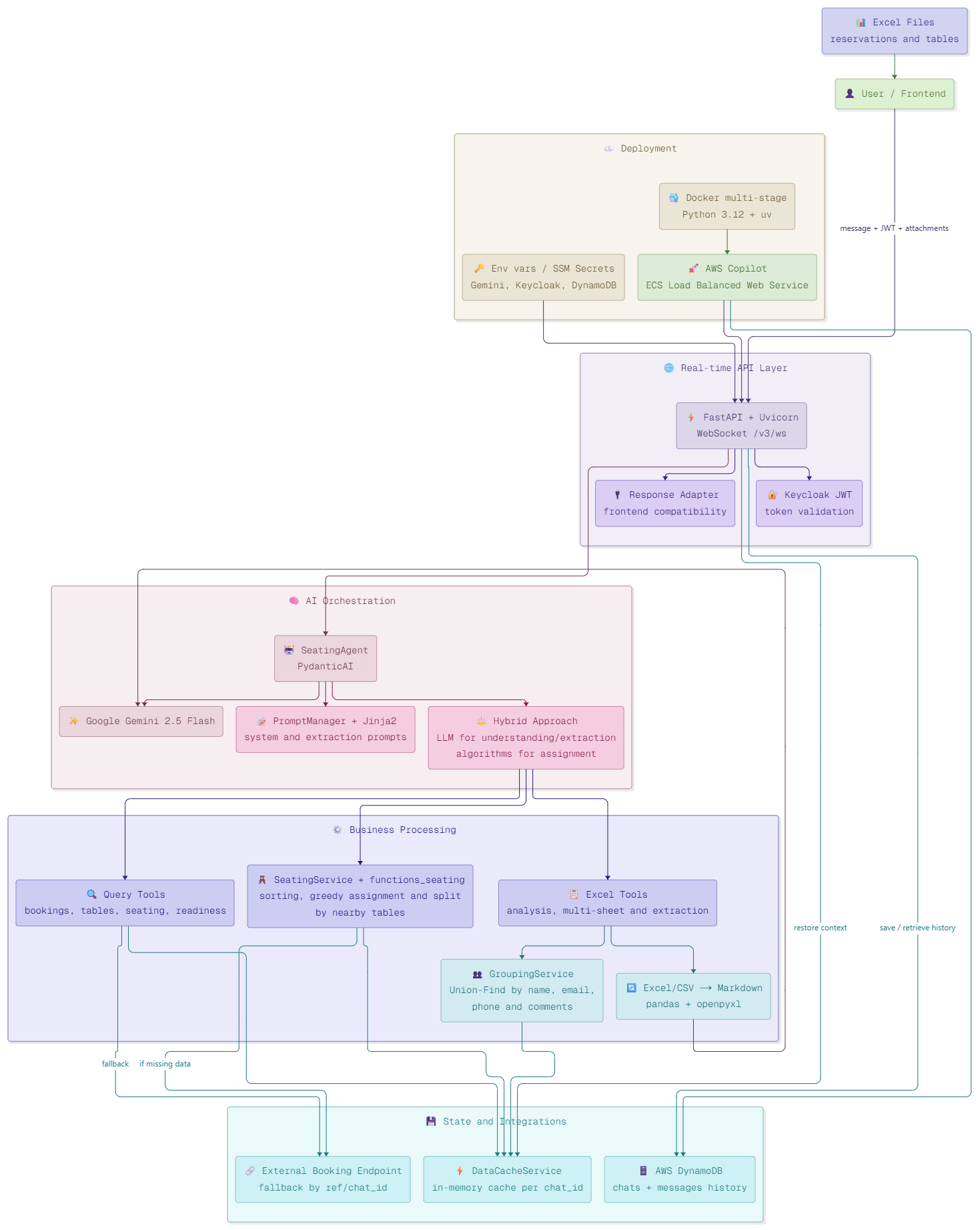
I designed the system as a conversational AI backend that combines LLM intelligence for understanding and extraction with deterministic logic for business-critical assignment decisions.
Real-time WebSocket interface
- The operations team connects via WebSocket (FastAPI + Uvicorn) and sends messages with optional Excel/CSV file attachments.
- Every connection is authenticated via JWT validated by Keycloak before any processing begins.
- The system supports both file-based interactions (upload and process) and pure conversational queries (ask about current state) through the same interface.
AI Agent with domain tools
- A PydanticAI agent powered by Gemini 2.5 Flash orchestrates the workflow, deciding which domain tools to invoke based on user intent and attached files.
- Dynamic prompts via Jinja2 adapt the agent's behavior to the current context - whether the user is uploading a new file, asking about a specific reservation, or requesting a seating assignment.
- The agent has access to specialized tools for Excel analysis, reservation extraction, table extraction, seating assignment, and operational queries.
File processing and data extraction
- The system analyzes Excel file structure including multi-sheet scenarios, detecting which sheets contain reservations and which contain table layouts.
- Reservation extraction handles heterogeneous formats, identifies relevant fields, and groups records that represent the same person across duplicate entries (matching by name, email, or phone).
- Table extraction maps available seating with capacity constraints and layout metadata.
Deterministic seating assignment
- Once reservations and tables are extracted, a heuristic assignment engine applies capacity constraints and business rules to produce a seating plan.
- This layer is fully deterministic - no LLM involvement in the actual assignment logic. The AI interprets and extracts; the rules decide.
- Results are returned as structured data that the frontend or downstream system can consume directly.
Conversational queries and session continuity
- After processing, the operations team can query the system in natural language: "How many unassigned reservations are left?", "Which table has the most capacity?", "Show me all bookings for Garcia."
- Conversation history is persisted in DynamoDB per chat session, so the user can disconnect and resume later without losing context.
- In-memory cache per chat_id keeps frequently accessed data fast for follow-up queries within the same session.
Key design decisions
- Hybrid AI + deterministic approach. The LLM handles what it is good at - understanding messy inputs, extracting structured data from unstructured files, and enabling natural language interaction. But the actual seating assignment is deterministic. Business-critical decisions do not depend on probabilistic model outputs.
- WebSocket-first architecture. File upload, processing, and conversational interaction happen through a single persistent connection. This eliminates the overhead of multiple HTTP round-trips and enables real-time streaming of results as processing progresses.
- Authentication before processing. JWT validation via Keycloak happens at connection time, before any message is processed. This keeps the security boundary clean and prevents unauthenticated requests from reaching the AI layer.
- Session persistence for operational continuity. DynamoDB stores the full conversation history per chat, so the system can restore context across sessions. Combined with in-memory caching, this means fast responses for follow-up queries without re-processing files.
- Schema-flexible file ingestion. The system does not require a fixed Excel template. It analyzes the structure of whatever file is uploaded - including multi-sheet workbooks with inconsistent formats - and adapts extraction accordingly. This is critical in hospitality where every venue has their own spreadsheet conventions.
Results in production
- Real-time processing of heterogeneous Excel files through a single WebSocket interface
- Automated extraction and deduplication of reservation records across inconsistent formats
- Deterministic seating assignment with capacity constraints and business rules
- Natural language query interface accessible to non-technical operations staff
- Full session continuity with persistent conversation history across reconnections
- Authenticated access with JWT/Keycloak ensuring secure multi-user operation
Tech Stack
| Layer | Technology |
|---|---|
| API & real-time communication | FastAPI, Uvicorn, WebSockets |
| AI agent & orchestration | PydanticAI, Gemini 2.5 Flash, Jinja2 dynamic prompts |
| File processing | pandas, openpyxl |
| Seating logic | Deterministic heuristic engine (Python) |
| Authentication | JWT, Keycloak |
| Persistence & caching | DynamoDB (history), in-memory cache per chat_id |
| Infrastructure | Docker, containerized deployment |
| Quality | pytest, pytest-asyncio, ruff |
Running operations on spreadsheets and manual coordination?
If your team is spending time before every service manually processing reservation files, cross-referencing capacity, and answering status questions from memory - and the logic is clear but the execution is still manual - this is the type of system I build.