AI-Powered Email Automation System
Delivery snapshot
Role: AI Engineer
Sector: Productivity and operations automation
Goal: Turn chaotic email inboxes into structured, automated workflows with traceability and human control
Measured impact
- Reduced daily email triage from 100+ items to 10-15 actionable items
- Automated classification, routing, and response generation across multiple email categories
- Two delivery channels: smart notifications and conversational assistant via Slack + RAG
- Full production observability with Langfuse (traces, cost per email, quality tracking)
- Presented as Technical Speaker at Datamecum Webinar 2025
Core stack
PydanticAI OpenAI FastAPI Celery PostgreSQL + pgvector Redis Slack Langfuse Docker
Challenge
The average professional receives over 120 emails per day and spends roughly 28% of their working time managing them. Critical messages get buried, responses are delayed, and the constant context-switching drains productivity.
The goal was to build a system that could automatically ingest incoming emails, understand their content, classify them by type and urgency, and execute the right action - all with full traceability and human oversight when needed. Not a filtering tool. A production pipeline that reads, decides, and acts.
Solution overview
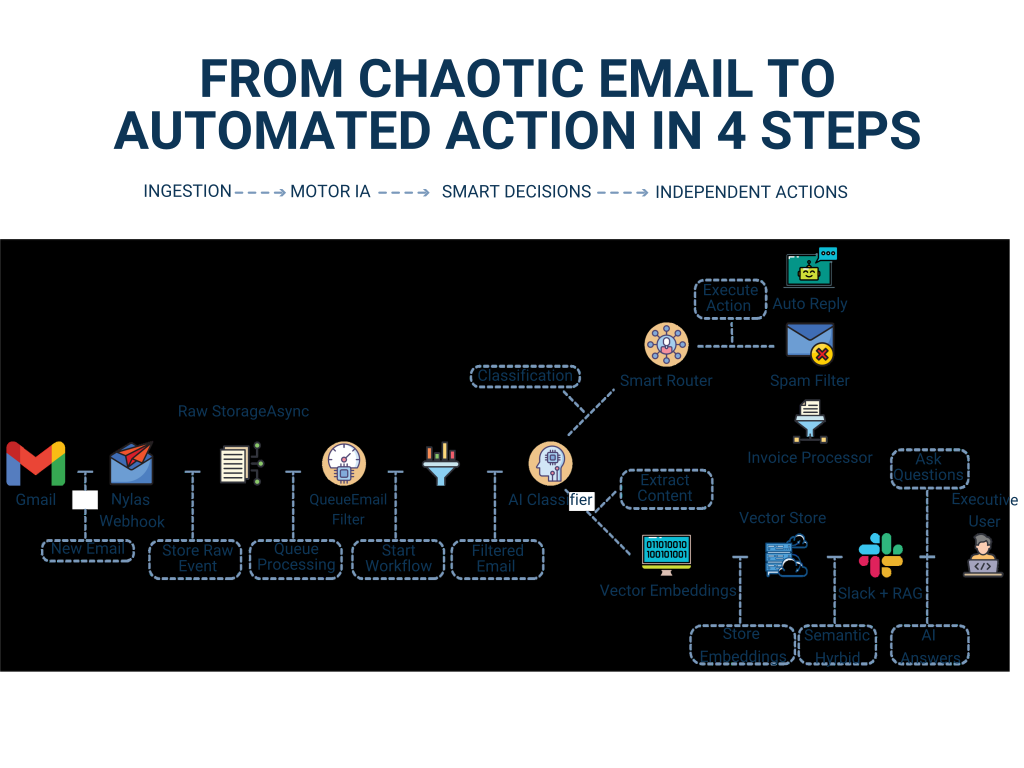 End-to-end solution diagram from the Datamecum Webinar 2025 presentation.
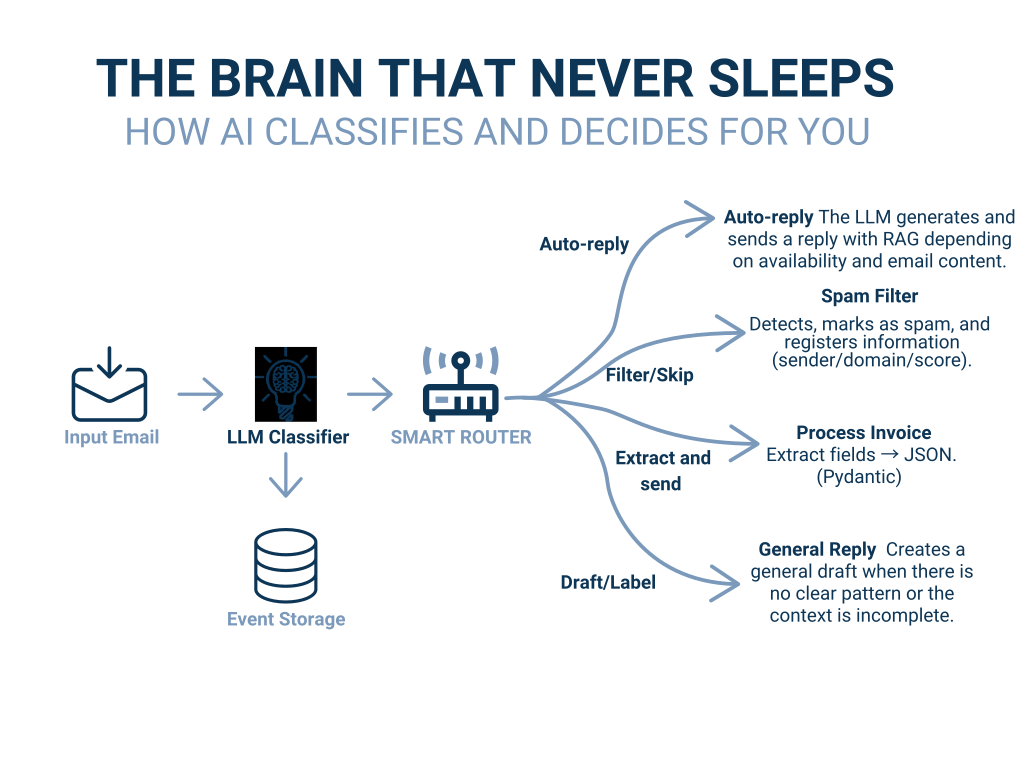 Classification flow: how the AI processes, classifies, and routes each email.
The system follows four stages: Ingestion → AI Engine → Smart Decisions → Autonomous Actions.
Ingestion
- Gmail integration via Nylas webhooks captures incoming emails in real time.
- Raw email events are stored asynchronously and queued for processing.
- An email filter pre-screens messages before any LLM processing, keeping inference costs predictable and avoiding wasted computation on irrelevant traffic.
AI Engine
- An LLM classifier (powered by OpenAI) analyzes filtered emails and extracts structured content using PydanticAI, producing validated, type-safe outputs - no free-form text leaves this stage.
- Extracted content is embedded into PostgreSQL + pgvector for semantic search and long-term context retrieval.
Smart Decisions
A deterministic smart router classifies each email and sends it down the right path:
- Auto-reply - The LLM generates and sends a context-aware response using RAG, grounded in availability and email content.
- Draft and label - Generates a polite draft when no specific template exists or context is insufficient, and labels the email for human review.
- Filter and discard - Detects spam, moves it to the spam folder, and logs evidence (sender, domain, score).
- Extract and forward - Pulls structured fields (JSON via Pydantic) from invoices and operational emails, then routes them downstream.
Autonomous Actions and Delivery
The system delivers results through two channels:
- Smart notifications - Proactive alerts pushed to Slack: urgent email detected, new invoice amount, spam moved, email snippets for quick context.
- Conversational assistant - A Slack-based RAG interface where the user can ask questions like "What invoices are pending?", "Summarize the last email from X", or "What did Y say about Z?" - all grounded in pgvector context.
Key design decisions
- LLM only where it adds value. Email filtering, routing logic, and storage are deterministic. The LLM handles classification, extraction, and response generation - the parts where unstructured language understanding is genuinely needed.
- Structured outputs everywhere. PydanticAI ensures every LLM response is validated against a schema before the workflow continues. If the output does not conform, the system retries or flags - it never silently passes bad data.
- Privacy and data control by design. Minimal OAuth scopes via Nylas, PII redaction and encryption, no vendor lock-in. The entire system runs on a Hetzner VM at a fraction of what enterprise suites cost.
- Full observability with Langfuse. Every email processed generates a trace: latency per node, LLM cost per email, token usage, model version, and quality annotations. Langfuse acts as the open black box of the pipeline - if something breaks or drifts, the trace shows exactly where and why.
- Horizontally scalable. Docker + FastAPI + Celery means the system can scale workers independently as email volume grows, without re-architecting.
Results in production
- Daily email triage reduced from 100+ items to 10-15 actionable items
- Automated classification and routing across multiple email categories
- Context-aware auto-replies generated and sent without manual intervention
- Conversational assistant enabling natural language queries over email history
- Full cost and quality observability per email processed
- Significantly lower infrastructure cost compared to enterprise email automation platforms
Tech Stack
| Layer | Technology |
|---|---|
| LLM & structured outputs | OpenAI, PydanticAI |
| Orchestration | Python, FastAPI, Celery |
| Email integration | Nylas (Gmail webhooks, minimal OAuth scopes) |
| Vector storage & RAG | PostgreSQL + pgvector, semantic hybrid search |
| Caching | Redis |
| Delivery channels | Slack (notifications + conversational assistant) |
| Observability | Langfuse (traces, cost tracking, quality annotations) |
| Infrastructure | Docker, Hetzner VM |
Watch the technical talk
This system was presented publicly at Datamecum Webinar 2025, walking through the full production architecture, the smart router design, the cost comparison with enterprise alternatives, and a live demo.

Losing hours to email triage every day?
If your team is manually sorting, classifying, and responding to high volumes of structured communications - and the decision logic is clear but the execution is still manual - this is the type of production pipeline I build.